
THE GENTLEMAN’S GUIDE TO SLUTTY SEX: STUDIES IN INTIMACY
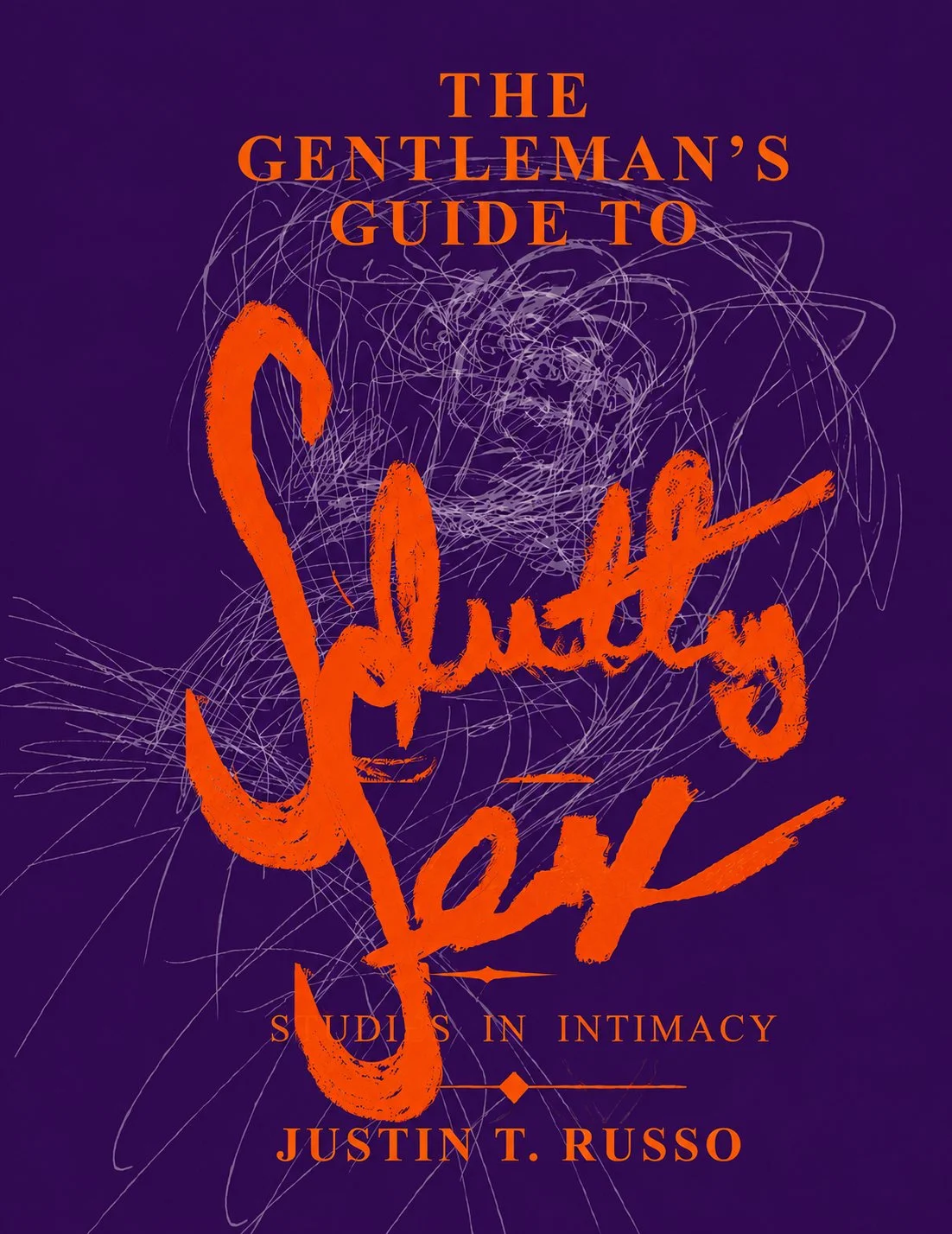
The Gentleman’s Guide to Slutty Sex: Studies in Intimacy
The Gentleman’s Guide to Slutty Sex: Studies in Intimacy begins with a cultural problem: many gay men reach adulthood fluent in desire, adaptation, performance, and sexual freedom, but without a shared emotional architecture for what people owe one another once intimacy begins. The Opening frames that absence as a question of conduct. The Prologue grounds it in Justin T. Russo’s own inheritance: an Italian family in which love was spoken behaviorally; a father whose suicide left behind both devotion and contradiction; a professional life built around art, provenance, preservation, and continuity; and a personal collapse that made documentation feel necessary as proof of life. What Russo initially believes is an archive of collapse gradually reveals itself as a study of Continuity.
Part One, The Gentleman’s Creed, establishes nine principles of relational conduct, including Filth Is Not the Opposite of Kindness, Presence Is Part of Consent, What Happens After Matters, and No Ghosting After Depth. The Creed does not ask gay men to become less sexual, adventurous, or desirous. It separates appetite from character and asks a more difficult question: what kind of man does desire reveal once another person’s body, trust, vulnerability, or hope enters the room?
Part Two tests that philosophy against sixty-five true studies drawn from twenty years of erotic encounter, romance, friendship, family inheritance, nightlife, addiction, recovery, grief, chosen family, and repair. The studies do not follow a conventional linear chronology. Each assumes the form native to its evidence—memoir, correspondence, field note, diary entry, mathematical proof, screenplay, theatrical ledger, or accession record—so the archive preserves not only what happened, but how the experience survived in memory. Across these entries, recognition becomes projection; tenderness collides with incompatibility; repair reaches its limit; family mythology shapes romantic expectation; erotic brotherhood becomes hierarchy; and trust, fidelity, violation, abandonment, community, and return are examined under pressure.
As the archive develops, Russo can no longer remain its detached curator. He becomes part of the evidence. He confronts his own compulsion to rescue, his tendency to shape men toward imagined future versions of themselves, his overreach, his disappearances, and the casualties created while he was trying to survive. The central movement is therefore not from promiscuity to restraint, nor from damage to sanitized healing. It is from desire as momentum to desire as stewardship—from asking what other men owe him to asking what he owes every person he has touched.
Part Three, The Practice, translates the archive’s ethical discoveries into lived instinct. Threshold replaces self-discovery with self-recognition. Power reframes desire as an engine rather than a navigator. Intention understands intimacy as continuation rather than permanence. Abundance separates discernment from scarcity. Hearth treats environment, ritual, and preparation as structures of self-support. Test submits the narrator to the same code he has applied to others, insisting that survival is not the same thing as innocence. Antithesis refuses to turn the philosophy into a universal rulebook. Finally, Warmth gathers the book’s argument into the ethic inherited from Russo’s grandmother Fay: the disciplined decision to remain fully human while another person’s story is standing in front of yours.
The book concludes with a fixed archival sequence: the final words, “The work continues…”; Russo’s childhood Care Bears drawing; a blank page; and a photograph of Fay. These artifacts reveal that the ethic guiding the adult archive was present before the life it documents. The child was not erased by what followed. He was carried through it.
The Gentleman’s Guide to Slutty Sex: Studies in Intimacy is a completed manuscript currently being represented to agents and shopped for publication.
Follow Studies in Intimacy on Patreon for new writing, drawings, archival material, field notes, and work developing beyond the manuscript.