ABOUT JUSTIN T. RUSSO:
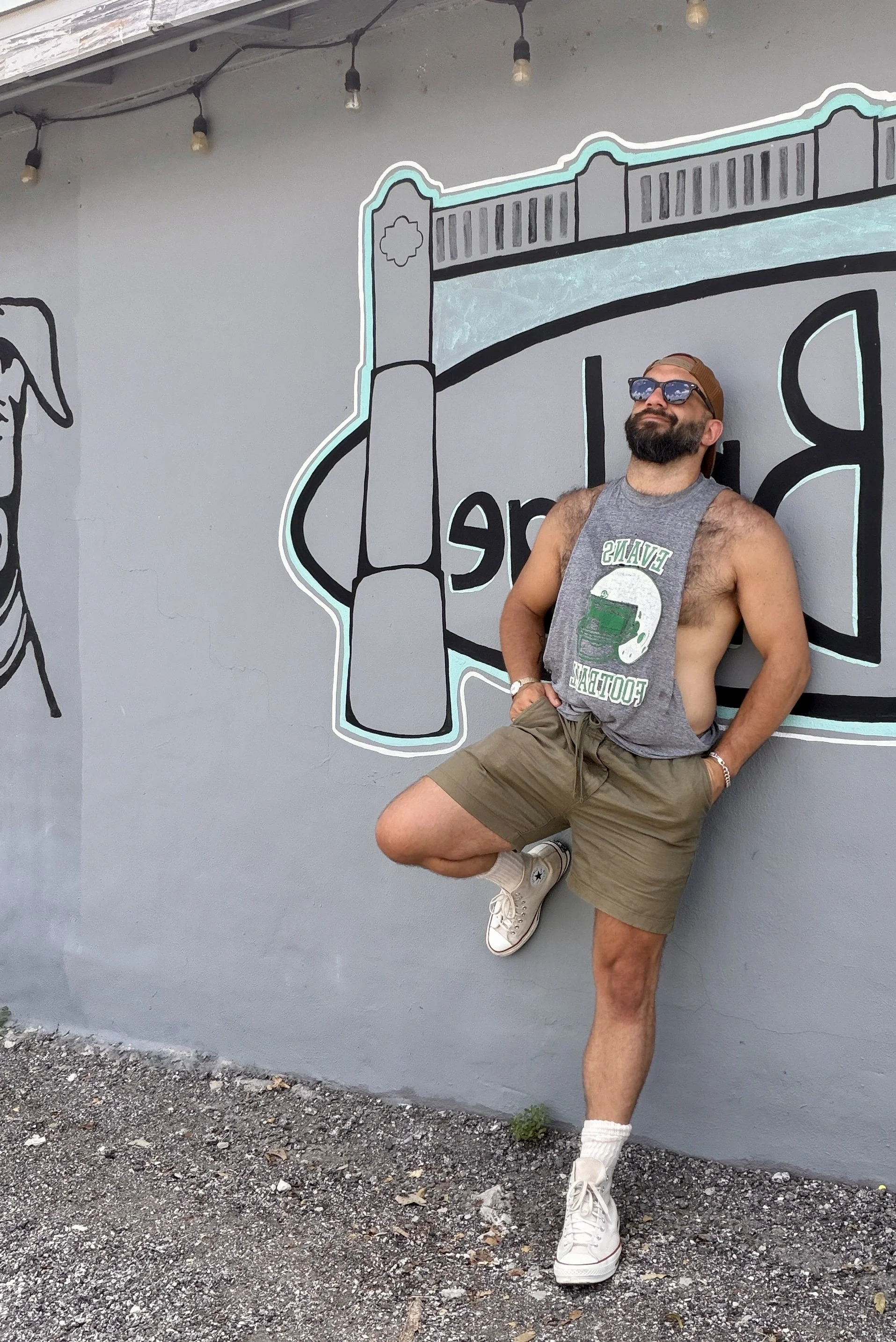
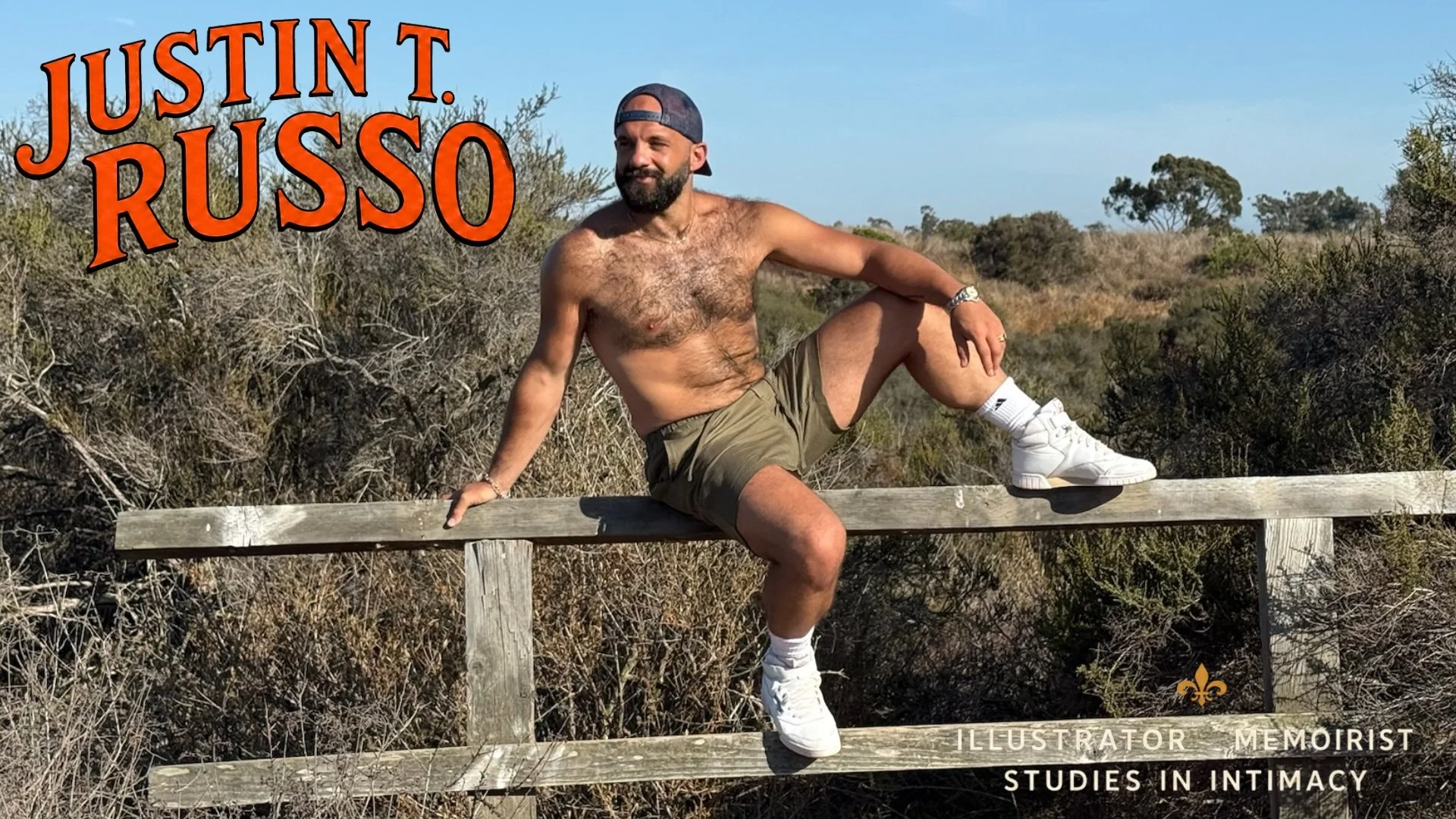
Justin T. Russo is a New York–based illustrator, curator, writer, and Intimacy Archivist. His work considers how human experience endures in images and objects, relationships and memory.
Across visual and literary forms, Russo traces the residue of experience through an archival and documentary sensibility. Queer Italian-American life provides its emotional ground, while Classic Hollywood and family history become lenses through which he considers masculinity, sexuality, grief, inheritance, and the complicated ethics of intimacy. Beneath the work lies a recurring question: what deserves to be preserved, and what changes when we choose to preserve it?
Russo began working professionally as an artist at fifteen. After studying Studio Art and Cinema Studies at New York University, he worked in Takashi Murakami’s studio, then built a career in art advisory and collections management with curatorial practice at its center. For more than a decade, he helped steward blue-chip private and corporate collections.
That experience profoundly shaped his understanding of art. Collections taught him that an object does not exist alone. Meaning gathers through provenance and placement, deepens through ownership and memory, and survives through conservation and the people entrusted with its care. Preservation is not passive. It is an act of attention.
Russo’s own drawings operate according to much the same principle. Working primarily in pencil, ink, and gouache, he relies on line and negative space, allowing restrained color to locate the emotional charge within an image. Line carries character. Negative space is not emptiness, but pressure: the silence around a figure, the distance between two bodies, the portion of the story the viewer is asked to complete.
Color is rarely ornamental. It establishes atmosphere, shifts emotional temperature, or punctuates the composition. In monochrome, contour and gesture carry the subject’s psychological weight; when color enters, it can interrupt or reframe the image as decisively as lighting alters a cinematic scene. Russo does not simply render a likeness; he constructs a frame. He approaches each image like a cinematographer, controlling the angle and crop, directing the sightline, and calibrating rhythm and scale to heighten the tension between what appears and what remains outside the composition. His drawings often resemble stills from scenes already in motion, with a face, a body, or the distance between figures carrying an emotional narrative far larger than the image itself.
At mural scale, that intimacy becomes civic. Russo carries historical reference into bold, site-specific compositions, where direct line and concentrated color place private feeling inside shared space. The murals do not abandon the intimacy of the drawings; they make it communal. Queer history and popular imagery become part of a neighborhood’s collective memory at street level.
His visual language is rooted in the image culture that formed him, particularly Classic Hollywood and the immediate postwar period, then refracted through queer history, family photographs, and the private iconography people carry through their lives. Rather than reproduce nostalgia, Russo is interested in what remains active inside it.
That movement between private image and public memory has carried Russo’s work into newspapers and theaters, across civic space, and finally into private collections. His illustration and public-art projects have been featured in various media outlets, including The New York Times; in 2019, he was selected as one of fifty artists to create a mural for WorldPride in New York. His work has been commissioned by or entered the collections of cultural figures such as Lauren Bacall, Billy Joel, Parker Posey, Kelly Ripa, Billy Porter, and Raúl Esparza. Bacall kept Russo’s portrait of her in her home, while his original artwork was featured as the centerfold for Billy Joel’s Last Play at Shea. These encounters matter not simply as provenance, but as proof that an image can enter another person’s life and continue there.
His practice has never remained neatly inside the art world. Russo appeared as a principal cast member on Logo’s Fire Island and later hosted Check Your Luggage, an LGBTQ+ travel series. Nearly two decades inside New York nightlife and queer social culture gave him another education: he watched people construct and reveal themselves, desire one another, disappear, return, and leave their imprint.
Russo began applying the archival instincts he had learned through objects to lived experience itself. Under the name NYCMeatball, he developed an erotic documentary and visual archive in which sex is treated not as disposable content, but as human evidence. Each encounter survives across film, drawing, photography, and correspondence, then continues through memory and aftermath; every record preserves something the others cannot.
The archive collapses the false borders between erotic life, art, and intellectual inquiry. It allows sexuality to coexist with seriousness, promiscuity with tenderness, and the body with the mind. Its subject is not merely what people do together, but what becomes visible through the doing and what remains once contact ends.
That investigation developed into Justin T. Russo: Studies in Intimacy, an ongoing interdisciplinary practice that binds visual and literary work to oral history and the family archive, extending the inquiry into cultural criticism and relational ethics. The work asks how a life can be documented without flattening the people inside it; how private experience enters cultural memory; and how intimacy can be preserved without being reduced to sentiment or spectacle.
His first book, The Gentleman’s Guide to Slutty Sex: Studies in Intimacy, extends that practice into literary nonfiction. Through sixty-five studies drawn from lived experience, Russo examines conduct by asking how people enter one another’s lives, what they owe while there, and what remains after they leave.
The movement from collections to bodies, from objects to relationships, is less a departure than a continuation.
Russo’s practice is ultimately one of stewardship. Across media, the work remains concerned with one fundamental act:
Preserving the complexity of human experience before it disappears.